Favourite writers, continued - Poets.
31. William Blake, largely for Jerusalem
32. T.S. Eliot. When I studied Eliot in 6th form I was either told, or believed independently, that Eliot was impenetrably hard. Not surprisingly I found him thus. Returning to Prufrock or the Wasteland decades later something has happened, and they have become accessible, almost conversational. I find it hard to explain this transformation except to suggest that it is more complicated than just me being a bit slow aged 17.
33. John Keats. Rich, sumptuous poetry. All the more extraordinary that he produced this body of work in such a few short years.
34. Wilfred Owen - I am not in a position to argue this in any detail, but I have a suspicion that Owen wasn't just our greatest war poet, but one of our greatest poets full stop. His works are compressed, intense, masterpieces, where every sound and syllable counts.
35. Shelley, for Masque of Anarchy, a brilliant piece of polemic which opens with this fantastic line about the Home Secretary, whom he accuses of responsibility for the Peterloo massacre:
"I met Murder on the way - He had a mask like Castlereagh"
And ends with this rousing call to arms:
"Rise like Lions after slumber
In unvanquishable number,
Shake your chains to earth like dew
Which in sleep had fallen on you-
Ye are many — they are few"
Which would make a great slogan for the Labour Party don't you think?
I also have a soft spot for Ozymandias:
36. Elizabeth Barrett Browning, for Sonnet from the Portugese.
"How do I love thee? Let me count the ways."
37. Kipling, for If. Nationalistic, misogynistic nonsense I know, but can't help loving it.
38. Rupert Brooke, for Granchester. The section on the women of Cambridgeshire is hilarious.
39. John Herrick. Obscure Elizabethan poet, but some great love poems,
40. Brian Patten. Witty, warm and wise.
"I caught a train that passed the town where you lived.
On the journey I thought of you."
Honourable mention to John Cooper Clarke for Evidently Chickentown http://www.youtube.com/watch?v=OGWhjojt5dw.
Having reviewed this list I can't avoid the suspicion I have favourite poems rather than favourite poets. So be it.
Tuesday, 17 July 2012

Sunday, 15 July 2012
Favourite authors (Three) - Playwrights
More favourite writers - playwrights this time.
21. Tom Stoppard - for Rosencrantz and Guildenstern are Dead, some delightful playing with ideas.
22. Samuel Beckett. When Waiting for Godot was first performed in the 1950's it left most audiences bewildered. It is a sign of the times that there can now be a passing reference to "Happy Days" (the one with the old people in the dustbins) in the Simpsons, and the writers assume that a good proportion of people (if not kids) will get it.
23. John Osborne. I fear "Look Back in Anger" would feel a bit dated now, no matter how it is staged - it is just one of those pieces specific to the post-War, post rationing 1950s. Maybe it would work in Keep Calm and Carry On austerity Britain, but I suspect not. Plenty of other decent work such as the Entertainer to justify inclusion.
24. Joe Orton. Full of wit, energy, and mischief. Favourite play - got to be "Loot", or "What the Butler Saw". His diaries and biography ("Prick up your Ears") are worth reading too.
25. Oscar Wilde. No-one can turn a phrase like Wilde.
26. Harold Pinter. Some extraordinary powerful work, exploring the mundane and banal; the dramatist who rescued silence. Favourite play - The Homecoming - intense, dramatic, incredibly subtle.
27. Noel Coward. A surprise inclusion maybe, but try Blithe Spirit.
28. George Bernard Shaw. Shaw explored some issues that most playwrights of his generation steered well away from. Now we think of Pygmalion and "I'm a good girl I am", but of course Shaw didn't marry off Eliza and Professor 'iggins.
29. Alan Ayckbourn, for "The Norman Conquests". Farce when well done is brilliant, but really complex to pull off, and in this sequence of plays Ayckbourn does it effortlessly.
30 Ben Jonson. Shakespeare's contemporary; far fewer of his works have survived, (or did he just write less?) but there is enough to show us how extraordinary the theatre of this time must have been.
A very white, male, English (the language rather than the country, of course) list, admittedly. But it would be fairly pointless claiming admiration for writers whose work I am less familiar with.
21. Tom Stoppard - for Rosencrantz and Guildenstern are Dead, some delightful playing with ideas.
22. Samuel Beckett. When Waiting for Godot was first performed in the 1950's it left most audiences bewildered. It is a sign of the times that there can now be a passing reference to "Happy Days" (the one with the old people in the dustbins) in the Simpsons, and the writers assume that a good proportion of people (if not kids) will get it.
23. John Osborne. I fear "Look Back in Anger" would feel a bit dated now, no matter how it is staged - it is just one of those pieces specific to the post-War, post rationing 1950s. Maybe it would work in Keep Calm and Carry On austerity Britain, but I suspect not. Plenty of other decent work such as the Entertainer to justify inclusion.
24. Joe Orton. Full of wit, energy, and mischief. Favourite play - got to be "Loot", or "What the Butler Saw". His diaries and biography ("Prick up your Ears") are worth reading too.
25. Oscar Wilde. No-one can turn a phrase like Wilde.
26. Harold Pinter. Some extraordinary powerful work, exploring the mundane and banal; the dramatist who rescued silence. Favourite play - The Homecoming - intense, dramatic, incredibly subtle.
27. Noel Coward. A surprise inclusion maybe, but try Blithe Spirit.
28. George Bernard Shaw. Shaw explored some issues that most playwrights of his generation steered well away from. Now we think of Pygmalion and "I'm a good girl I am", but of course Shaw didn't marry off Eliza and Professor 'iggins.
29. Alan Ayckbourn, for "The Norman Conquests". Farce when well done is brilliant, but really complex to pull off, and in this sequence of plays Ayckbourn does it effortlessly.
30 Ben Jonson. Shakespeare's contemporary; far fewer of his works have survived, (or did he just write less?) but there is enough to show us how extraordinary the theatre of this time must have been.
A very white, male, English (the language rather than the country, of course) list, admittedly. But it would be fairly pointless claiming admiration for writers whose work I am less familiar with.
Friday, 13 July 2012
Favourite Authors (Two)
Favourite authors - fantasy and science fiction
- Douglas Adams. I first encountered Douglas Adams' work on the radio, which is probably where it worked best. This must have been the late 70's I guess. I can still remember the time and place, (if not the date). The books are a joy - try the Dirk Gently series as well.
- Tolkien. Teenage fiction perhaps, but captivating stuff. Outside the LoTR and the Hobbit, pretty unreadable. I have a sneaking suspicion that the films were better than the books, but it's been a while since I read the latter.
- C.S.Lewis. Going back even further into my childhood now, but as an eight/nine year-old I found the Narnia series entrancing and magical. The Last Battle is a travesty of epic proportion, but forgivable as long as I don't ever have to read it to my kids!
- Eoin Colfer. The Artemis Fowl series is for late pre-teens, and is very inventive, with some nicely dark stuff in there as well. Make sure you read them in the right order!
- Terry Pratchett. DiscWorld is an as well realised a creation as any other on this list.
- JK Rowling. What JKR does is so deceptively simple - when I first read HP and the Philosopher's Stone I thought "I could do that" - but by the end of the series I was utterly hooked. It was great fun being part of the journey as well, and a fairly unique experience (yes, I know you can't qualify an absolute, but you know what I mean) - no-one will ever read the Deathly Hallows again wondering if JKR would have the audacity to kill off her main character, as seemed inevitable at more than one point. No-one will ever do the midnight queue for the next instalment (unless Shades of Grey continues to sell in the way it has over the last few weeks)
- Roald Dahl. Pre-teen again - inevitably I guess given the topic. I am sure there is some adult sci-fi/fantasy out there but I just haven't read it yet. Any recommendations? Some slightly more grown-up writers are...
- Kurt Vonnegut, for Slaughterhouse 5.
- Max Brooks - for World War Z. Zombie fiction can be very repetitive, but Brooks' use of fractured first person statements works very effectively.
- Jasper Fforde - especially the Thursday Next books.
Just missing out - HG Wells, Jules Verne, as well as all traditional sci-fi writers such as Asimov and Clarke.
Thursday, 12 July 2012
Favourite Authors (One)
As this will be my 50th blog entry, I thought I would succumb to some list writing - in this case my 50 favourite authors. Now I haven't prepared this list in advance, although I have of course given it some thought, so who knows if I will get to 50?
DJJ
- Shakespeare. Of course.
- Stella Gibbons - see earlier blogs for some fan mail.
- Mervyn Peake, the stunningly brilliant author of the Gormenghast trilogy
- George Orwell. Never wrote an uninteresting word. If you have read 1984 and Animal Farm, and chances are you have, try the essays or journalism, or even the much under-appreciated (including by GO himself) minor novels such as Burmese Days, Coming Up for Air, or Keep the Aspidistra Flying.
- Raymond Chandler - see blog entry 49.
- Anthony Burgess - best known for Clockwork Orange, but I have a real soft spot for the Enderby novels - really funny. There is a scene where Enderby, the poet, cooks spaghetti carbonara badly - doesn't sound funny I know but try it.
- Kingsley Amis - 95% of which is for Lucky Jim of course.
- Evelyn Waugh - try "The Loved Ones".
- Jane Austen - an author you are supposed to like, but I wonder how many people just make do with the TV adaptation? But I genuinely believe she is better on the page, where the subtlety can emerge at it own speed.
- Charles Dickens - I have read all the principal novels many moons ago, but there is so much more to explore.
DJJ
The Big Sleep - Raymond Chandler - 1939
Chandler is one of my favourite writers - top 5 at least, and pretty much everything he published is consistently readable. As such I don't really have a favourite novel of his but if forced to choose it would probably be "The Big Sleep". This is Chandler at his sublime best. Philip Marlowe, his iconic hard boiled detective, a loner, is the quintessential private eye, the model on which so many detectives down the ages have been based upon. We see the action through his detached, sardonic perspective, although even then many things we are left to work out for ourselves.
The principal attraction of these novels - "The Lady in the Lake", "Farewell my Lovely", "The Long Goodbye", "The Little Sister" - all classics - is not the plotting, tight though this is, but the prose - Chandler had an ability to craft a phrase like few others. Take this opening from "The Big Sleep" for example, probably one of the best ever written:
 "It was about eleven o'clock in the morning, mid October, with the sun not shining and a look of hard wet rain in the clearness of the foothills. I was wearing my powder-blue suit, with dark blue shirt, tie and display handkerchief, black brogues, black wool socks with dark little clocks on them. I was neat, clean, shaved and sober, and I didn't care who knew it. I was everything the well-dressed private detective ought to be. I was calling on four million dollars."
The plot is extremely complex, not that it matters. Marlowe is employed by the ailing General Sternwood to investigate a small blackmail problem. In doing so Marlowe gets involved with pornographic book lending (which in today's world is almost cute), gambling, boot-legging, gangsters, and several murders. The story flies along at such pace that you don't actually spot the join - the book was originally two shorter stories, welded together to make the novel. This is done with such craftsmanship that you don't notice unless you are looking for it - and even then it doesn't matter a jot. (End of chapter 19 if you are interested - everything is tied up neatly at that point with only the missing persons investigation, which Marlowe isn't really supposed to be conducting, outstanding).
 If you haven't read Chandler before you are in for a treat. This is as good a place to start as any - it's his first Marlowe novel. In Philip Marlowe we have one of the great literary characters - as well realised and fully rounded as any I can think of. Some Christians exhort people to ask "What would Jesus would do?". With all possible respect to these individuals, I often wonder whether "What would Marlowe do?" would offer better advice. That won't mean too much if you haven't read the books, so you know what to do now, don't you?
The principal attraction of these novels - "The Lady in the Lake", "Farewell my Lovely", "The Long Goodbye", "The Little Sister" - all classics - is not the plotting, tight though this is, but the prose - Chandler had an ability to craft a phrase like few others. Take this opening from "The Big Sleep" for example, probably one of the best ever written:
 "It was about eleven o'clock in the morning, mid October, with the sun not shining and a look of hard wet rain in the clearness of the foothills. I was wearing my powder-blue suit, with dark blue shirt, tie and display handkerchief, black brogues, black wool socks with dark little clocks on them. I was neat, clean, shaved and sober, and I didn't care who knew it. I was everything the well-dressed private detective ought to be. I was calling on four million dollars."
Doesn't that make you want to stop and go and read the book itself? Go on, I won't be offended. The dark little clocks are a great touch.
The plot is extremely complex, not that it matters. Marlowe is employed by the ailing General Sternwood to investigate a small blackmail problem. In doing so Marlowe gets involved with pornographic book lending (which in today's world is almost cute), gambling, boot-legging, gangsters, and several murders. The story flies along at such pace that you don't actually spot the join - the book was originally two shorter stories, welded together to make the novel. This is done with such craftsmanship that you don't notice unless you are looking for it - and even then it doesn't matter a jot. (End of chapter 19 if you are interested - everything is tied up neatly at that point with only the missing persons investigation, which Marlowe isn't really supposed to be conducting, outstanding).
 If you haven't read Chandler before you are in for a treat. This is as good a place to start as any - it's his first Marlowe novel. In Philip Marlowe we have one of the great literary characters - as well realised and fully rounded as any I can think of. Some Christians exhort people to ask "What would Jesus would do?". With all possible respect to these individuals, I often wonder whether "What would Marlowe do?" would offer better advice. That won't mean too much if you haven't read the books, so you know what to do now, don't you?
 Tuesday, 10 July 2012
The Long Earth - Terry Pratchett and Stephen Baxter
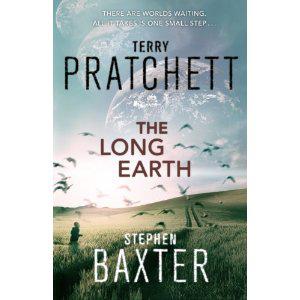
Occasionally a new series is announced on television. The director is someone well known, the lead actors are famous, the production has obviously (from the trailers) had a lot of money spent on it. So you tune in with high expectations.... but end up a bit underwhelmed - the whole is less than the sum of the parts. Somewhere the story has been lost.
The premise of the novel is simple but well realised. The idea of multiple parallel universes has been around for a long time, but Pratchett/Baxter's idea is to ask - "What if we could travel easily to and from these worlds?" This is the "Long Earth" of the title. The challenge these writers faced was to take this idea and overlay it with a story, without letting the conceit overwhelm the narrative. Broadly speaking I don't think they achieved this. They explore a lot of the issues that the Long Earth presents - how would migration to these new worlds affect the old earth, what about those who are unable to travel, (stepping), what would the new worlds be like - almost like an intellectual exercise. New species and civilisations are discovered, but the heart of the novel is a journey to the far reaches of the Long Earth to discover a new form of intelligent life, that may or may not represent a threat to the rest of civilisation.
There are a huge number of threads left hanging at the end of the novel - the mysterious Black corporation, for example, is mentioned in passing as some kind of global MegaCorp, but this goes nowhere. Joshua the main character is built up as a messiah-like figure and there are references to "the Silence" that aren't properly explored or explained. Equally there is little of the typical Pratchett whimsy - the organic matter that drives the stepping devices is a potato (why?), and we are told about but do not meet a religious cult that believes all of existence is a practical joke. There are also some obvious traces of Pratchett in the character of Lobsang, a hyper-intelligent robot that passes the Turing test and claims to be the reincarnated spirit of a Tibetan priest. But the lightness of touch which usually characterises Pratchett's writing is largely missing. In its stead are long passages describing the journey West through the long earth. (Incidentally, the journey West is a deliberate and explicit echo of the journey across the Wild West of the USA, without the red indians/native americans.
Pratchett started a story based on the idea of the Long Earth and stepping between worlds, in the 1980's, and abandoned it, presumably because he wasn't able to craft a story out of it. DiscWorld might have got in the way a bit as well. Bringing in a sci-fi writer (Baxter is often described as a "hard sci-fi" writer - I can only guess this means he doesn't normally include any fantasy element in his work) to help finish the work was misconceived - Pratchett already had the sci-fi component of his story, what he needed was a strong plot to bring to life the world he had created.
Despite a literal big bang, the book actually ends with a bit of a whimper, and it is made obvious that we are being invited to participate in a series of novels - the Long Earth perhaps becoming the new DiscWorld, with characters such as the police officer we meet but who has very little to do in this novel becoming more central, having their own plot lines, etc. If that inference is correct it is a fine ambition, and I am sure I will keep reading - for now.
Monday, 2 July 2012
Lucky Jim - Kingsley Amis
Lucky Jim – Kingsley Amis
I am conscious that I have written a run of pretty negative reviews in recent weeks, so to redress the balance and cheer myself up a little I have just re-read an old favourite, Kingsley Amis’s 1954 novel “Lucky Jim”.
 Jim Dixon is a lowly academic at a provincial Midlands university. He hates his job, his boss, his “digs” (ie lodgings), his colleagues – he doesn’t even like his girlfriend very much. The novel follows his struggle to impress his boss sufficiently to avoid getting the push, which involves having a pointless piece of research published, delivering an end of term lecture on "Merrie England", and generally brown-nosing his boss and his boss’s family for all he is worth. ("Educating Rita" nicked the drunken end of term speech by the way). Because every instinct within him objects to this he does a poor job of it, and only avoids being dismissed through his titular luck in being offered a much more desirable job out of academia.
The comedy derives from Jim’s inability to express his rage and frustration. His interior monologue expresses this anger effectively enough, but externally he has to keep up a pretence. This conflict leads him to self sabotage – most dramatically at a weekend stay at his boss's house when he gets drunk and starts a small fire in his bedroom (see quotes below).
The expression “laugh out loud” is used far too often in the context of books – I see the phrase on the blurbs of books quite regularly - but I can honestly say in all my journeys to work and back I have never heard anyone burst out loud with laughter when reading a book. But "Lucky Jim" genuinely, hand on heart, makes me laugh, out loud. Out of context quotes probably lose much of their impact, but I still find the description of Jim’s drunken escapades at Welch’s house really funny; his description of getting, being, and recovering from being, drunk are completely spot on.
Here's some of the scene with Jim slowly realising just how drunk he is:
"It wasn't as nice in the bathroom as it had been in the bedroom. Though it was a cool night for summer he found he felt hot and was sweating. He stood for some time in front of the wash basin, trying to discover some more about how he felt. His body seemed swollen below the chest, and uneven in density. The stuff coming from the light seemed less like light than a very thin but cloudy phosphorescent gas; it gave a creamy hum" (Chapter 5)
"It wasn't as nice in the bathroom as it had been in the bedroom. Though it was a cool night for summer he found he felt hot and was sweating. He stood for some time in front of the wash basin, trying to discover some more about how he felt. His body seemed swollen below the chest, and uneven in density. The stuff coming from the light seemed less like light than a very thin but cloudy phosphorescent gas; it gave a creamy hum" (Chapter 5)
And this is the hangover description, one of the best I have ever read, which opens chapter 6:
"Dixon was alive again. Consciousness was upon him before he could get out of the way; not for him the slow gracious wandering from the halls of sleep, but a summary, forcible ejection. He lay sprawled, too wicked to move, spewed up like a broken spider crab on the tarry shingle of the morning. The light did him harm, but not as much as looking at things did; he resolved, having done it once, never to move his eyeballs again....His mouth had been used as a latrine by some small creature of the night, and then as its mausoleum. During the night, too, he'd somehow been on a cross-country run and then been expertly beaten up by secret police. He felt bad."
Note incidentally that this isn't just funny, but it is clever and well written too - the creamy hum quote for instance is a great example of a "I know what you mean" kind of imagery.
Lucky Jim has a strong period feel. This is very clearly recovering post-war Britain, with the war and rationing fresh in everyone’s minds. References to the war are scattered through the novel like a background noise. The contrast between Dixon as a representative of a new generation, wanting to break free of the shackles of pre-War Britain, and his many opponents, is a precursor of the coming rebellions of the 1960s. I appreciate Dixon isn’t a political figure, and would resist being co-opted into any rejection of traditional values – Amis was deeply conservative, not to say misogynist. Much of Dixon’s anger comes from his sexual frustration – his girlfriend Maureen places strict boundaries on their relationship. But we don’t read Lucky Jim because of its social commentary.
Lucky Jim has a strong period feel. This is very clearly recovering post-war Britain, with the war and rationing fresh in everyone’s minds. References to the war are scattered through the novel like a background noise. The contrast between Dixon as a representative of a new generation, wanting to break free of the shackles of pre-War Britain, and his many opponents, is a precursor of the coming rebellions of the 1960s. I appreciate Dixon isn’t a political figure, and would resist being co-opted into any rejection of traditional values – Amis was deeply conservative, not to say misogynist. Much of Dixon’s anger comes from his sexual frustration – his girlfriend Maureen places strict boundaries on their relationship. But we don’t read Lucky Jim because of its social commentary.
Despite this period feel I was delighted at the extent to which the novel had not dated. Normally humour doesn’t age well – try watching Fawlty Towers today; what was once side splitting now hardly raises a smile. But "Lucky Jim" speaks to some timeless themes – frustration with authority and the eternal internal struggle between doing what is right and doing what one wants.
Amis in later years degenerated into a bit of a self parody, and never met the heights of Lucky Jim again. That’s not to say his other novels are not worth reading – I found "The Green Man" for example quite compelling when I read it many years ago, and he won the Booker in 1986 for the Old Devils – but his grumpiness eventually became just a bit too insistent. But if you haven't read it before, or even if you have, give yourself a treat with this gem.
Subscribe to:
Posts (Atom)